
Garbage Disposal Smells Bad Even After Cleaning? Common Causes
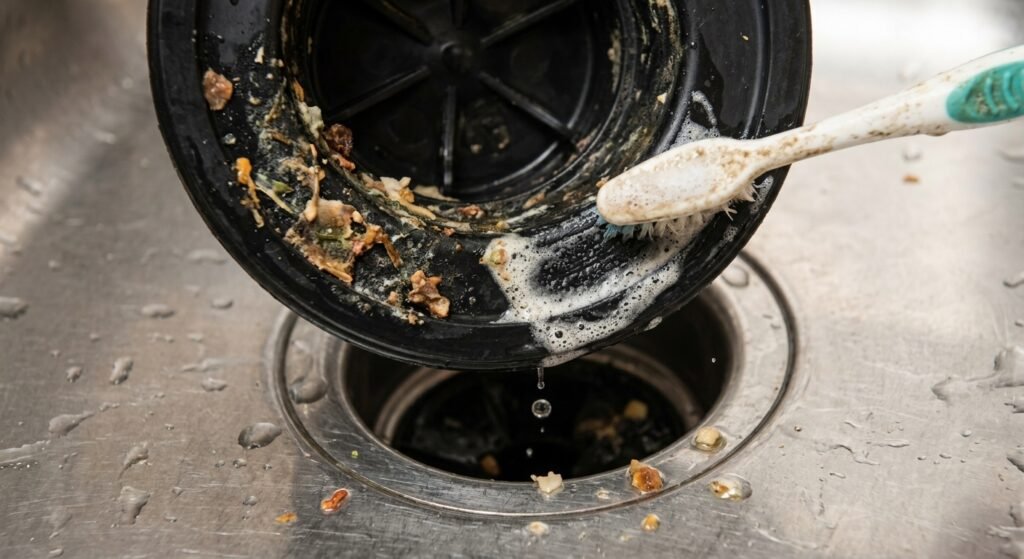
If a garbage disposal still smells after cleaning, the odor often comes from food residue hidden under the splash baffle, inside the grind chamber, or farther down the connected drain. Grease can also trap organic material. Before assuming the disposal itself has failed, determine where the odor is strongest and whether the sink is draining normally.
A kitchen sink can look perfectly clean while something underneath still smells sour, rotten, or stale.
That is because the visible sink opening is only part of the system.
Food particles can collect on surfaces you cannot easily see from above, especially around the splash baffle and upper portion of the disposal. InSinkErator’s current maintenance guidance identifies food buildup in the grind chamber and baffle as a common source of disposal odor.
If cleaning helps for only a few hours—or does nothing at all—the next step is not adding more fragrance.
It is figuring out where the odor is actually coming from.
What Kind of Disposal Odor Do You Have?
| What You Notice | What It May Suggest |
| Rotten-food smell strongest at the sink opening | Food residue inside or around the disposal |
| Smell disappears after cleaning but quickly returns | Hidden buildup may remain |
| Odor is strongest around the rubber splash baffle | Residue under or around the baffle |
| Greasy, stale-food smell | Grease film may be holding food residue |
| Bad odor plus slow sink drainage | Connected drain may also contain buildup |
| Sewer-like odor that persists after cleaning | Drainage or plumbing source becomes more plausible |
| Smell appears from more than one drain | Problem may extend beyond the disposal |
| Burning or electrical odor while unit runs | Stop using the unit; this is not a normal cleaning issue |
Odor alone does not tell you that the disposal motor or entire unit has failed.
First separate a dirty disposal from a drainage problem.
Cause #1: Food Residue Is Still Inside the Disposal
Food particles can remain inside the disposal even when the sink opening looks clean.
Small pieces of food can collect inside the grind chamber over time.
Moist organic material left in a dark, wet environment can create a persistent odor even though there is no obvious piece of food visible from above.
InSinkErator specifically identifies accumulated food particles in the grind chamber and baffle as a common odor source.
Why Does the Smell Return After You Already Cleaned It?
Often, the cleaning reached only the surfaces that were easy to see.
For example, rinsing the sink may clean:
- the visible basin;
- the top of the drain opening; and
- some loose material inside the disposal.
It may not remove residue attached to less-visible surfaces.
That is why deodorizing the sink and actually removing the source of the odor are not always the same thing.
Cause #2: The Underside of the Splash Baffle Is Dirty
The rubber splash baffle around the disposal opening can collect food residue on surfaces that are difficult to see from above.
The splash baffle is the flexible rubber section at the sink opening.
It helps limit splashing while the disposal operates, but food particles can collect around it.
InSinkErator’s official odor-cleaning instructions specifically recommend cleaning the underside of the baffle and the accessible upper lip of the grind chamber.
Why This Area Is Easy to Miss
From above, the rubber may look clean.
The underside can be a different story.
If the smell becomes noticeably stronger when you lift or inspect the flexible baffle, residue in that area may be contributing to the odor.
This is one of the first places worth checking before assuming something deeper in the plumbing is wrong.
Cause #3: Grease Is Holding Food Residue in the Drain Path
Grease can coat drainage surfaces and make it easier for organic material to remain behind.
Pouring cooking grease into a disposal does not make the grease disappear.
The City of Covington’s sanitary sewer rules specifically recognize that oil and grease can deposit in sewer lines, clog sewers, or impede wastewater flow. The City’s grease-control section also explains that grease can cool, solidify, and combine with other material in sewer piping.
For a homeowner, the practical takeaway is simple:
A garbage disposal is not a grease-disposal system.
Avoid intentionally pouring:
- cooking oil;
- bacon grease;
- meat fat;
- fryer oil; or
- other concentrated fats
into the sink.
Grease residue can also hold small food particles that later create odor.
Cause #4: Not Enough Water Is Moving Food Through the Disposal
Insufficient water flow during and after disposal use can allow food residue to remain behind.
InSinkErator directly associates some disposal odors with insufficient water flow and recommends operating the disposal with a moderate flow of cold water, then allowing the cold water to continue briefly after grinding is finished.
The goal is not simply to wet the food.
The water helps move processed material out of the disposal and into the drainage system.
Use Cold Water During Normal Grinding
Manufacturer guidance recommends cold water while grinding food waste.
After the food has cleared, allow the water to continue briefly rather than shutting the disposal and faucet off at exactly the same moment.
Cause #5: The Disposal May Be Clean but the Drain Is Not
If the disposal has been cleaned thoroughly and the odor remains, the connected sink drain may be the actual source.
The disposal is only one part of the kitchen drainage path.
Material can accumulate farther downstream where it is not visible from the sink opening.
Pay attention to whether the odor is accompanied by:
- slow drainage;
- water lingering in the sink;
- recurring gurgling;
- odor that remains even when the disposal has not been used; or
- similar odors from other drains.
Those symptoms shift the investigation away from simple disposal cleaning and toward the drainage system.
What If the Garbage Disposal Smells Like Sewer?
A sewer-like smell deserves a different diagnostic approach from an ordinary rotten-food odor.
Food buildup typically produces a sour, decaying, or stale-food smell.
If the odor is distinctly sewage-like and returns after the disposal and baffle have been cleaned, consider whether the source may be farther down the plumbing.
Additional clues include:
- slow sink drainage;
- gurgling;
- odors from multiple drains;
- water backing up into the sink; or
- other drainage problems occurring at the same time.
Do not keep adding deodorizing products if the symptom pattern points toward a drain problem.
If the kitchen sink is also draining slowly or repeatedly backing up, see our drain cleaning and sewer line service information for the next diagnostic path.
How to Safely Clean a Smelly Garbage Disposal
Cleaning should focus on removing actual buildup rather than simply covering the smell.
InSinkErator’s current odor procedure focuses on disconnecting power, cleaning the baffle area, and flushing loosened material away.
Step 1: Turn Off and Disconnect Power
Do not clean around the disposal opening while the unit can accidentally turn on.
Turn the disposal off and disconnect its power supply before cleaning accessible disposal surfaces.
InSinkErator specifically instructs users to disconnect power before its odor-cleaning procedure.
Step 2: Never Reach Into the Grind Chamber
Do not put your hand inside the garbage disposal.
The manufacturer expressly warns against placing a hand inside the unit.
The cleaning goal is the accessible baffle and upper surfaces—not reaching deep into the mechanism.
Step 3: Clean the Splash Baffle Thoroughly
With the power disconnected, clean accessible surfaces around:
- the rubber splash baffle;
- the underside of the baffle; and
- the upper lip of the grind chamber.
These are common places for hidden residue to remain.
Step 4: Flush Away Loosened Material
InSinkErator’s published odor-cleaning method uses warm sink water with 1/4 cup of baking soda, followed by operating the disposal to wash loosened particles away.
Follow the instructions applicable to your disposal model rather than improvising with multiple household chemicals.
Step 5: Use Adequate Cold Water During Future Operation
Once normal operation resumes, use a moderate flow of cold water while grinding and continue the water briefly afterward.
That can help reduce the amount of food material left behind.
Should You Keep Pouring Different Cleaners Into a Smelly Disposal?
No. If the smell repeatedly returns, focus on locating and removing the source instead of continuously adding different cleaners.
A product that temporarily masks odor does not necessarily remove:
- food under the splash baffle;
- residue inside the grind chamber;
- grease farther down the drain; or
- another plumbing-related odor source.
Also avoid casually mixing household cleaning chemicals.
If you use a disposal-cleaning product, follow the disposal manufacturer’s instructions and the cleaner’s label.
The objective is source removal, not stronger fragrance.
Why Does the Smell Come Back So Quickly?
An odor that returns shortly after cleaning usually means some of the odor-producing material remains or the true source was never cleaned.
Ask yourself four questions:
Did You Clean Under the Splash Baffle?
If not, hidden residue may remain directly beneath the visible sink opening.
Does the Sink Drain Normally?
If water drains slowly, buildup may extend farther into the drainage path.
Is the Odor Strongest Only at the Disposal?
If not, the disposal may be getting blamed for a broader sink-drain problem.
Are You Regularly Sending Grease or Large Amounts of Food Waste Down the Sink?
Changing what enters the drain may matter as much as cleaning what is already there.
Is a Smelly Garbage Disposal Broken?
A bad smell by itself does not prove that the disposal has mechanically failed.
If the unit otherwise operates normally and the sink drains properly, start by investigating food buildup and the baffle area.
Mechanical service becomes a separate issue when the problem is no longer just odor.
For example, if the disposal develops an operating problem, abnormal mechanical behavior, or a leak, move away from cleaning troubleshooting and have the unit evaluated.
For those issues, see our Covington garbage disposal service page.
This article intentionally focuses only on odor diagnosis and cleaning, not mechanical troubleshooting, repair pricing, installation, or replacement.
When the Smell Points to the Drain Instead of the Disposal
The combination of odor plus drainage symptoms is more important than odor alone.
| Symptom Pattern | Where to Focus First |
| Disposal smells but sink drains normally | Disposal/baffle buildup |
| Odor returns quickly after surface cleaning | Hidden residue |
| Odor plus slow drainage | Connected drain |
| Odor plus recurring gurgling | Drainage system |
| Similar smell from multiple drains | Broader plumbing source |
| Sewage entering sink | Active drainage problem |
| Non-food burning odor during operation | Stop using unit and seek service |
This distinction can prevent repeated disposal cleaning when the actual problem is farther downstream.
Covington Homeowners: Keep Grease Out of the Sink
Local sewer rules provide a good reason not to use the disposal as a way to get rid of cooking grease.
Covington’s municipal code states that grease can deposit in sewer lines and impede flow. Its grease-control program also explains how FOG—fats, oils, and grease—can cool, solidify, and combine with other material inside sewer piping.
Those provisions primarily regulate the City’s sanitary sewer system and food-service discharges, so they do not prove that grease causes every residential kitchen problem.
But the homeowner takeaway remains useful:
Put concentrated cooking fats and oils in an appropriate waste container instead of intentionally sending them through the disposal.
What to Note If the Odor Still Will Not Go Away
Before seeking plumbing help, note these details:
| Detail | Why It Helps |
| Where the smell is strongest | Helps separate disposal from drain |
| Whether the sink drains normally | Identifies possible downstream involvement |
| How quickly odor returns after cleaning | Shows whether hidden buildup may remain |
| Whether the baffle was cleaned | Rules out a common hidden area |
| Whether grease frequently enters the sink | Adds buildup context |
| Whether other drains also smell | Suggests a broader plumbing source |
| Whether water is backing up | Moves problem toward drainage diagnosis |
A simple description such as:
“The disposal operates normally and the baffle has been cleaned, but the smell returns the next morning and the kitchen sink is draining slowly.”
is much more useful than:
“My garbage disposal smells bad.”
Garbage Disposal Odor FAQs
Still Smelling Something Wrong at the Kitchen Sink?
If cleaning the accessible disposal and splash-baffle areas does not solve the problem, determine whether the kitchen drain is also slow, gurgling, leaking, or backing up.
For disposal-related service options in the Covington area, visit our garbage disposal service page.
Serving Covington and surrounding St. Tammany Parish service areas.