
No Hot Water in Covington, LA? Common Gas and Electric Water Heater Problems Explained
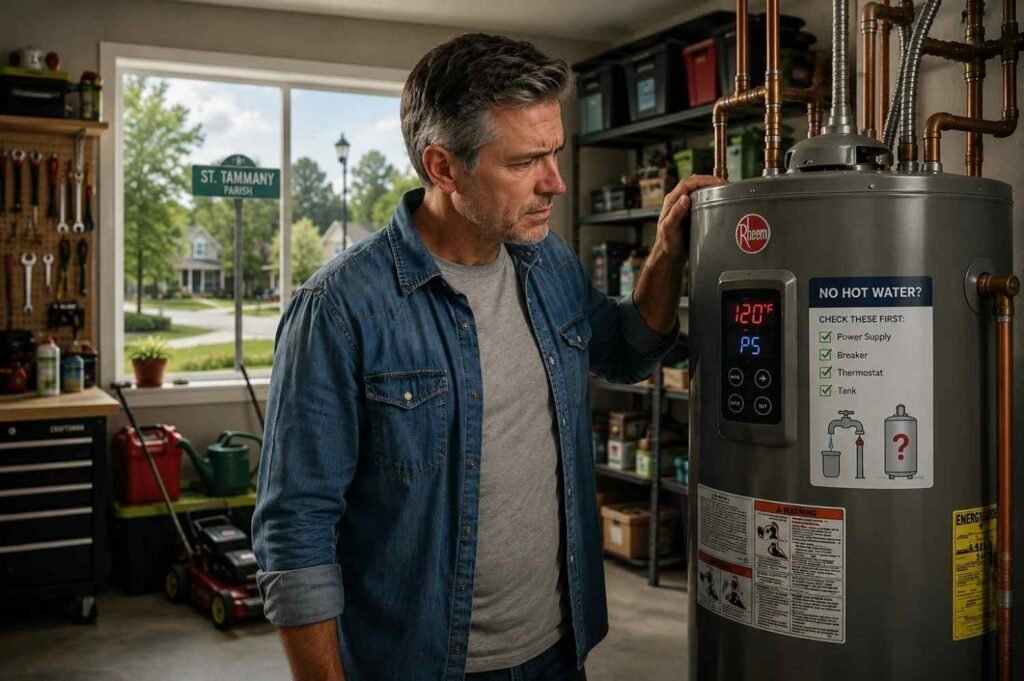
If your whole house suddenly has no hot water, first determine whether the problem affects every fixture and whether your water heater is electric, gas, or tankless. A completely cold home points more toward the heater or its energy supply, while one affected shower or faucet can indicate a fixture-specific problem instead.
That distinction matters because “no hot water” is a symptom—not a diagnosis.
Quick Diagnosis Summary
| What You Notice | What It Can Point Toward | What to Check or Record |
| No hot water anywhere | Water-heater or system-wide problem | Heater type, power/fuel status, error lights |
| Only one shower or faucet affected | Fixture or mixing-control issue | Which other fixtures still get hot |
| Electric heater completely cold | Power, heating-element or control issue | Breaker status and model number |
| Gas heater completely cold | Ignition, burner, fuel or control issue | Status light, pilot/ignition behavior |
| Water stays lukewarm | Reduced heating performance | Whether every fixture is affected |
| Water starts hot then turns cold | Capacity, recovery or component problem | How long useful hot water lasts |
| Tankless unit stops heating | Flow, ignition or model-specific fault | Display/error code |
Start Here: Is the Entire House Without Hot Water?
Testing two or three fixtures is one of the fastest ways to separate a water-heater problem from a single-fixture problem.
Try the kitchen sink, a bathroom faucet, and a shower before assuming the heater itself has failed.
No hot water at any fixture
If every hot-water fixture runs cold, the water heater or its power, gas, ignition, or heating system becomes a stronger suspect.
The next clues are the type of heater you have and whether it shows a status light, error code, or other obvious change in operation.
Only one shower or faucet has no hot water
If other fixtures get normally hot water, the water heater may be working correctly.
The affected shower or faucet may have a cartridge, mixing valve, temperature-control, or other fixture-specific problem.
A.O. Smith’s troubleshooting guidance similarly uses checks at multiple faucets to help distinguish whole-system problems from fixture-specific issues.
The water gets warm but never fully hot
Lukewarm water usually means the system is still producing some heat, but it is not reaching or maintaining the expected temperature.
Depending on the heater type, the issue may involve heating performance, a control, a heating element, household demand, or another component.
The shower starts hot but quickly turns cold
Hot water that runs out quickly is a different symptom from a heater that produces no hot water at all.
Useful clues include how long the hot water lasts, whether the problem has appeared suddenly, and whether it happens during one shower or only when several fixtures or appliances use hot water close together.
Covington-Specific Factors Worth Checking
Local context can help troubleshoot a problem, but it should be based on your actual utility, property, and recent conditions—not assumptions about every Covington home.
Your water source can vary by where you live
The City of Covington Public Works Department lists water wells among the infrastructure it maintains. The city’s utility information also notes that properties outside Covington city limits may be served by other providers, including Water District #2, Water District #3, Lee Road Water, and Tammany Utilities West.
That means it is not accurate to assume every Covington or St. Tammany Parish property has identical water chemistry.
If scale or mineral buildup is suspected, use the actual water-quality information for your utility—or a water test—rather than assuming “Covington water is hard.”
After a Northshore freeze, rule out a supply problem too
After freezing weather, a lack of hot-water flow does not automatically mean the water heater failed.
The National Weather Service has issued freeze warnings affecting northern St. Tammany Parish and specifically warned that unprotected outdoor plumbing can be damaged by freezing conditions.
If a problem begins immediately after a freeze, compare cold- and hot-water flow at several fixtures. Reduced or absent flow may point toward a plumbing-supply issue that needs to be separated from the heater itself.
Older Covington properties deserve a system-specific check
Covington has a protected historic district containing older structures, alongside newer development elsewhere in the area.
In an older or substantially remodeled property, focus on the water heater that is actually installed today—not assumptions based on the home’s age.
Record whether the current unit is gas, electric, or tankless, where it is installed, and any model information visible on the data plate.
Why an Electric Water Heater May Have No Hot Water
An electric water heater can stop producing hot water because of lost electrical power, a failed heating component, or a control problem.
Manufacturer troubleshooting resources specifically identify circuit-breaker, heating-element, thermostat, and high-limit-control issues among common electric-water-heater faults.
The heater may have lost power
A tripped circuit breaker can leave an electric water heater completely cold.
You can visually check the electrical panel to see whether the water-heater breaker appears tripped.
If the breaker repeatedly trips, however, do not keep resetting it and treating the symptom as solved. Repeated tripping can indicate an electrical or equipment fault that requires proper diagnosis.
Do not remove energized electrical covers or test internal components unless you are qualified to perform that work.
A heating element may have failed
A failed electric heating element can cause either no hot water or reduced hot-water capacity, depending on the system and failure.
Electric tank heaters commonly use heating elements controlled by thermostats. A technician may need to electrically test the components to determine which part, if any, has failed.
A thermostat or high-limit control may be involved
Controls can also interrupt normal heating even when the tank still contains water and the plumbing itself works normally.
A.O. Smith lists thermostat problems and tripped high-limit/ECO controls among relevant electric water-heater troubleshooting categories.
If a safety control repeatedly trips, the underlying cause should be diagnosed rather than repeatedly reset.
Why a Gas Water Heater May Have No Hot Water
A gas water heater needs a working fuel supply, ignition system, burner, and control system to produce hot water.
If the burner cannot ignite or remain operating when heat is needed, the plumbing may still deliver water normally—but the water will remain cold.
The pilot or ignition system may not be operating
A pilot or ignition failure can prevent the burner from heating the tank.
Some gas heaters use a standing pilot, while newer units may use other ignition systems.
Rather than dismantling the heater, note whether there is a visible pilot, a status light, or a control display.
The heater may show a fault or status indication
A flashing status light or error code can be more useful than the general complaint “my water is cold.”
Before calling for service, photograph:
- the status light or display;
- any error code;
- the model number;
- the serial/data plate; and
- the control position, without changing settings unnecessarily.
Manufacturer-specific fault information can then be checked against the correct model.
If you smell gas, stop troubleshooting
If you smell or hear leaking gas, leave the home immediately and contact the appropriate gas authority from outside.
The U.S. Consumer Product Safety Commission advises occupants not to operate lights, phones, or other electronics before leaving when a gas leak is suspected.
A suspected gas leak is a safety emergency—not a routine water-heater troubleshooting task.
What If You Have a Tankless Water Heater?
A tankless water heater can lose hot-water output because of flow, ignition, control, or model-specific fault conditions.
Gas tankless systems operate differently from storage tanks: when hot water is requested, a flow sensor detects demand and activates the burner, which heats water through a heat exchanger.
Useful first observations include:
- whether an error code appears;
- whether every fixture is affected;
- whether the problem occurs only at low flow;
- whether the unit attempts to ignite; and
- whether the problem started suddenly or has become progressively worse.
Write down the exact error code rather than repeatedly resetting the heater.
The manufacturer’s documentation for the specific model is more useful than a generic internet diagnosis.
What If Hot Water Runs Out Too Quickly?
If you initially have hot water but lose it much sooner than before, the heater is producing heat but may not be maintaining enough usable capacity or recovery.
Possible categories include:
- unusually high household demand;
- reduced heating performance;
- an electric heating-element problem;
- thermostat/control performance;
- a heater that is undersized for current usage; or
- conditions inside a storage tank that reduce effective performance.
A.O. Smith distinguishes “not enough hot water” from a total “no hot water” condition and notes that heating-element, thermostat, capacity, and sediment-related issues can affect available hot water.
Before calling, note approximately how many minutes the water stays hot and whether the symptom occurs consistently.
A Technician-Style Troubleshooting Sequence You Can Use Safely
The most useful troubleshooting is not guessing the failed part—it is collecting the right clues in the right order.
Use this sequence without opening electrical or gas components:
1. Check more than one fixture
Confirm whether the problem affects the whole house or just one faucet or shower.
This separates system-wide and fixture-specific possibilities.
2. Identify the heater type
Determine whether the installed unit is electric, gas, tankless, or another type.
A photo of the entire unit is often enough if you are unsure.
3. Describe the temperature accurately
Record whether the water is completely cold, lukewarm, or initially hot before turning cold.
Those are different diagnostic clues.
4. Look for an error or status light
Record what the heater is already telling you before changing settings.
Take a photo rather than trying to memorize a flashing pattern.
5. Photograph the model and data plate
The model information helps a service provider use the correct manufacturer troubleshooting documentation.
This is particularly useful for tankless and electronically controlled systems.
6. Mention recent events
Tell the service provider if the symptom began after:
- a power interruption;
- a freeze;
- plumbing work;
- a prolonged water shutoff;
- flooding or water exposure near the appliance; or
- another unusual event.
These details can change the diagnostic starting point.
Does No Hot Water Mean You Need a New Water Heater?
No—complete loss of hot water does not automatically mean the entire water heater needs replacement.
A tripped breaker, failed electric heating component, ignition problem, or control fault can stop a heater from producing hot water without proving that the complete unit has reached the end of its usable life. Manufacturer troubleshooting guidance includes several repairable causes of no-hot-water complaints.
The right repair-versus-replacement decision depends on the actual failure and overall condition of the heater.
If the unit itself needs professional diagnosis, our guide to water heater repair and installation in Covington, LA explains the service, repair, and replacement side in more detail.
Before Calling for Water Heater Service in Covington, Gather These 5 Details
Five pieces of information can make the first conversation with a service provider much more useful.
- Heater type: gas, electric, tankless, or other.
- Affected fixtures: whole house or only one area.
- Exact symptom: cold, lukewarm, or runs out quickly.
- Status information: flashing light, display, or error code.
- Model information: clear photo of the data plate.
This avoids vague descriptions and gives the provider a better starting point before an on-site diagnosis.
Need help with a water-heater problem?
to connect with an available plumbing service provider serving Covington and the surrounding area.