
Water Heater Leaking From the Bottom in Covington, LA? What It Can Mean
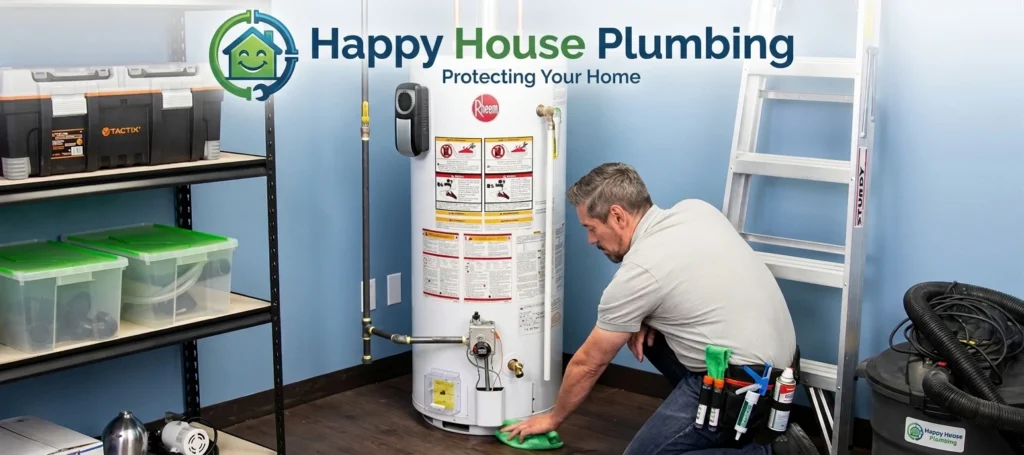
Water around the bottom of a water heater does not automatically mean the tank has failed. The moisture may come from the drain valve, T&P relief system, plumbing connections, condensation, an electric heating-element gasket, or the tank itself. If water is actively spreading, control the water supply and keep clear of electrical or gas hazards before trying to identify the source.
A puddle underneath your water heater can look straightforward: water is at the bottom, so the tank must be leaking from the bottom.
But water flows downward.
A leak that begins near the top of the heater can run along the jacket and collect at the base. A dripping valve can do the same thing. Even condensation can sometimes create moisture that looks like a plumbing leak.
The most useful first question is therefore not:
“Is there water under the heater?”
It is:
“Where is the water actually coming from?”
Where Is the Water Coming From?
| What You Notice | Possible Source | What It May Mean |
| Dripping from valve near bottom | Drain valve | Valve or connection may be leaking |
| Water from relief discharge pipe | T&P relief system | Pressure, temperature, expansion, or valve issue |
| Wet trail down side of tank | Plumbing connection above | Leak may not originate at bottom |
| Moisture after heavy hot-water use | Condensation possible | Confirm source before assuming tank failure |
| Water near lower element on electric unit | Heating-element gasket | Component-area leak possible |
| Water seeping from tank jacket or base seam | Tank itself | More serious tank failure possible |
| Water collecting in drain pan | Several possible sources | Trace water upward before diagnosing |
Do not use puddle location alone to decide that the tank needs replacement.
First, Make Sure the Leak Is Really Coming From the Bottom
Water naturally collects at the lowest point, so the bottom of the heater may only be where the leak becomes visible.
Before assuming the tank has failed, inspect the outside of the heater without removing electrical or gas components.
Look for a Wet Trail Down the Tank
Water running down the outside of the heater can reveal that the actual leak started higher up.
Use a flashlight and look at the exterior jacket.
Check whether moisture appears to be traveling down from:
- the top plumbing connections;
- a nearby valve;
- a relief discharge pipe;
- another pipe above the heater; or
- a nearby plumbing fixture.
If the side of the tank is wet above the puddle, the water may simply be collecting at the base.
Check the Hot and Cold Water Connections
A leaking inlet or outlet connection can drip onto the heater and make a top leak appear to be a bottom leak.
Look around the visible plumbing connections at the top of the unit.
You are looking for moisture—not attempting to tighten or dismantle pressurized fittings while the system is leaking.
Check the T&P Discharge Pipe
Water from the temperature-and-pressure relief system can travel to the floor and create a puddle near the heater.
Look for visible moisture at the discharge pipe or around the relief-valve area.
Do not plug, cap, or block the discharge pipe.
Dry the Area and Watch Where Moisture Returns
If the leak is slow, drying accessible exterior surfaces can make the source easier to identify.
Use a dry towel around visible, safe-to-touch areas and observe where moisture first reappears.
Do not remove electrical covers, burner panels, or other components simply to find the leak.
Cause #1: The Drain Valve May Be Leaking
A leaking drain valve near the bottom of the tank can create a puddle that looks like a failed water heater tank.
The drain valve is typically used when the tank needs to be drained or flushed.
A leak may occur:
- from the valve opening;
- around the valve connection;
- because the valve is not sealing completely; or
- after the valve has previously been opened for maintenance.
Because the valve is positioned low on the tank, water from this area naturally collects directly underneath the heater.
Does a Leaking Drain Valve Mean the Tank Is Bad?
Not necessarily.
A drain-valve leak and a tank-body leak are different problems.
The source should be confirmed before deciding whether the entire water heater needs replacement.
Avoid forcing an older drain valve open or closed aggressively, especially if it already appears damaged.
Cause #2: Water May Be Coming From the T&P Relief System
A temperature-and-pressure relief valve can release water that eventually collects beneath the heater.
The T&P valve is an important safety device designed to relieve excessive temperature or pressure inside a storage water heater.
A discharge from this system should not simply be treated as an annoying drip.
Possible factors can include:
- excessive system pressure;
- thermal expansion;
- excessive water temperature;
- a valve that is not sealing correctly; or
- another condition that requires diagnosis.
Never Plug a T&P Discharge Pipe
Do not cap, plug, clamp, or otherwise block a T&P relief discharge line to stop water from coming out.
The system is designed to relieve potentially unsafe conditions.
Stopping the discharge without identifying why it is occurring can create a serious safety problem.
A Dripping T&P Valve Does Not Always Mean the Valve Itself Is Bad
The valve may be responding to another condition in the plumbing system.
That is why simply replacing the valve without checking temperature, pressure, and system conditions may not solve the underlying problem.
Cause #3: A Leak From Above May Be Running Down the Tank
Water leaking from plumbing above the heater can travel down the jacket and collect at the bottom.
This is one of the easiest ways to misdiagnose a water-heater leak.
Possible sources include:
- hot-water outlet connection;
- cold-water inlet connection;
- nearby shutoff valve;
- flexible connector;
- piping joint; or
- another plumbing line above the unit.
A puddle directly beneath the heater still does not prove that the internal tank is leaking.
Trace the water upward whenever it can be done safely.
Cause #4: An Electric Heating-Element Gasket May Be Leaking
On an electric tank water heater, moisture can sometimes escape around a heating-element gasket and collect lower on the unit.
Electric storage heaters commonly use heating elements installed through the side of the tank.
A sealing problem around an element can allow moisture to appear around the element area and then travel downward.
Do Not Remove Electrical Covers While the Unit Is Energized
Water and energized electrical equipment are a dangerous combination.
If water is near electrical components, covers, or wiring, avoid opening the unit to investigate.
Electrical testing and element removal should be handled only after the equipment is safely de-energized and by someone qualified to perform the work.
Cause #5: It Could Be Condensation Instead of a Plumbing Leak
Not every small amount of moisture around a water heater comes from a failed plumbing component.
Under some operating conditions, condensation can form and create moisture around the appliance.
This can be especially confusing when the moisture eventually reaches the floor.
How Can You Tell the Difference?
Look at the pattern.
Ask:
- Is the moisture intermittent?
- Does it appear after significant hot-water use?
- Is there a clear drip from a valve or fitting?
- Does water continue accumulating even when the heater is not operating?
- Can you trace the moisture to a specific component?
If water continues spreading or the source cannot be confidently identified, treat it as a potential leak until proven otherwise.
Cause #6: The Tank Itself May Be Leaking
If water is confirmed to be escaping through the tank body, jacket, or bottom seam, the internal tank may have failed.
This is different from water merely collecting underneath the heater.
A confirmed tank-body leak is more serious because a storage tank is designed to hold many gallons of water continuously.
Signs that deserve prompt evaluation include:
- water seeping directly from the base seam;
- moisture repeatedly appearing from beneath the jacket;
- an increasing puddle with no visible external valve or fitting leak;
- corrosion around the lower tank area; or
- water continuing to escape after other external sources have been ruled out.
Can a Leaking Tank Be Repaired?
A confirmed leak from the storage tank itself generally points toward replacement rather than a simple component repair.
The important word is confirmed.
A puddle underneath the heater alone is not enough to make that diagnosis.
What Should You Do If the Water Is Actively Spreading?
If water is actively spreading across the floor, prioritize safe shutdown and water control before trying to determine the exact failed component.
1. Keep Away From Electrical Hazards
Do not step into standing water if electrical outlets, wiring, appliances, or the electrical panel may be involved.
2. Control the Heater’s Water Supply
If the cold-water shutoff serving the heater is safely accessible and clearly identified, closing it may stop additional water from entering the tank.
If the water continues or you cannot safely isolate the heater, the home’s main water shutoff may be necessary.
3. Treat Hot Discharge Water Carefully
Water escaping from a water heater or T&P discharge system may be hot enough to cause injury.
Do not place your hands directly into flowing discharge water to identify its source.
4. Do Not Open Electrical or Gas Components
Do not remove electrical covers or dismantle gas controls while troubleshooting an active leak.
5. Take Photos After the Situation Is Controlled
Once the area is safe, document where the water appears to originate and how far it has spread.
Water Heater Leak Spreading?
- Call 877-853-8217
- 24/7 Emergency Plumbing Dispatch
- Typical Emergency Response: 30–45 Minutes
- Serving Covington and surrounding St. Tammany Parish service areas.
- Severe weather, traffic, location, and high emergency-call volume can affect actual arrival time.
Is a Leaking Water Heater an Emergency?
A growing or uncontrolled water-heater leak is urgent because continued water flow can damage the surrounding property and create additional safety hazards.
Not every drip carries the same level of urgency.
| Situation | Priority |
| Water actively spreading across floor | Urgent |
| Water near electrical equipment | Immediate safety concern |
| Gas odor present | Leave and follow gas-emergency procedures |
| T&P system releasing significant hot water | Safety concern |
| Small drain-valve drip | Needs diagnosis |
| Confirmed tank-body leak | Prompt replacement evaluation |
| Light intermittent condensation | Confirm source and monitor |
Active Water Is Spreading
If the puddle is getting larger, control the water supply rather than waiting to see whether the leak stops on its own.
Water Is Near Electrical Components
Do not treat this as an ordinary plumbing drip.
Keep away from standing water near energized equipment.
The Leak Is Small but Persistent
A slow leak should still be identified before it becomes a larger problem.
Small leaks can worsen, damage surrounding materials, or indicate a component that is deteriorating.
What If You Have a Gas Water Heater?
A gas water heater adds combustion and fuel-supply concerns, so avoid dismantling burner or gas-control components while investigating a leak.
You can visually inspect accessible exterior areas for water without opening the combustion system.
If you smell natural gas:
- leave the property;
- do not continue troubleshooting;
- do not operate electrical switches while remaining in the affected area; and
- contact the appropriate gas emergency service from a safe location.
A water leak and a suspected gas leak should be treated as two separate safety issues.
What If You Have an Electric Water Heater?
Water near electrical covers, wiring, or energized components can create a shock hazard.
Do not remove heating-element access panels or attempt electrical testing while the unit is energized.
If water is actively reaching electrical equipment and the electrical controls cannot be accessed safely, stay away from the wet area and seek appropriate assistance.
The goal is not to diagnose an element or thermostat while standing beside an active leak.
Water Heater Leaks in Covington Homes: Location Matters
Where the heater is installed can affect how quickly a leak is noticed and what the escaping water can damage.
Covington includes older properties around Historic Downtown as well as newer homes throughout the surrounding Northshore area.
Water heaters may be installed in different locations depending on the home, including:
- utility closets;
- garages;
- interior mechanical spaces;
- raised-floor or crawlspace properties;
- upper areas or attics in some homes; or
- other dedicated utility locations.
A Garage Leak May Be Easier to Notice
A heater installed on a visible garage floor may reveal a puddle before water reaches finished living space.
Even then, the leak source still needs to be identified.
A Closet or Interior Leak Can Affect Finished Materials Quickly
Water in an interior utility closet can spread into drywall, flooring, cabinets, or nearby rooms before the puddle becomes obvious.
Check adjacent areas if the leak has been present for an unknown amount of time.
Older and Newer Covington Homes Can Have Different Access Conditions
The age of the house alone does not diagnose the plumbing problem, but construction and access can affect how the leak is investigated.
An older raised-floor property may provide different access than a newer slab-based home.
Describe the heater location and surrounding construction when requesting service.
Does Covington Water Cause Water Heaters to Leak?
Do not assume that every Covington property has the same water conditions or that mineral content is automatically responsible for a leak.
Properties in and around Covington can be served by different water systems.
If mineral scale, corrosion, or water chemistry is suspected, use information from the property’s actual water provider or testing rather than assuming every St. Tammany Parish home has identical water conditions.
This is especially important when deciding whether visible sediment or scale is actually related to the current leak.
Does a Bottom Leak Mean Repair or Replacement?
The source determines the answer: some valve, fitting, gasket, or pressure-related leaks may be repairable, while a confirmed tank-body leak generally requires replacement.
Do not make the repair-versus-replacement decision based only on the location of the puddle.
The unit’s actual failure, condition, and leak source should be identified first.
For more information about professional diagnosis and service options, visit our Water Heater Repair & Installation in Covington, LA page.
Before Calling, Gather These 6 Details
A few observations can make the initial water-heater assessment much more useful.
| Detail | Why It Helps |
| Gas or electric heater | Determines safety and diagnostic path |
| Where water first appears | Helps locate the real leak source |
| Whether the drain valve is wet | Identifies one possible component |
| Whether the T&P discharge pipe is wet | Shows relief-system involvement |
| Whether water is running down the tank side | Suggests the source may be higher |
| Photo of model/data plate | Helps identify the exact unit |
Also note:
- whether the puddle is growing;
- whether the water is hot or cold;
- whether the heater is still producing hot water;
- whether the leak started suddenly; and
- whether recent maintenance or plumbing work occurred.
Take a photo before wiping away all visible moisture if it is safe to do so.
Well water homes in Abita Springs
Water Heater Leak FAQs
Water Heater Leaking in Covington? Get Help Now
If water is actively spreading, control the water supply first if it can be done safely.
24/7 Emergency Plumbing Dispatch
Typical Response Time: 30–45 Minutes
24 Hours a Day · 7 Days a Week