
Why Are Multiple Drains Backing Up at Once? Main Sewer Line Warning Signs
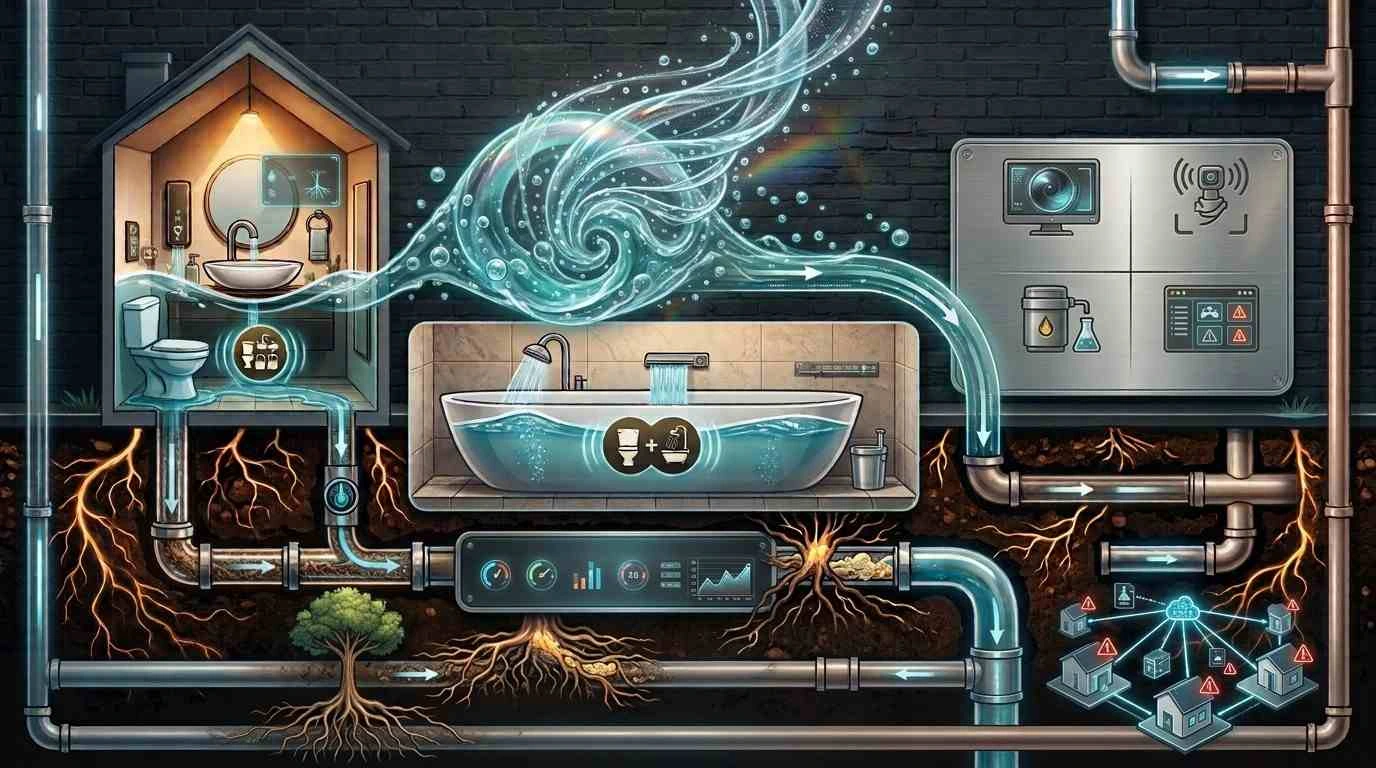
When several drains start backing up around the same time, the restriction is more likely to be in a shared downstream drain or sewer line than at one individual fixture. The exact location still needs diagnosis, because similar symptoms can come from a branch drain, the home’s sewer lateral, a deeper blockage, or—in some cases—a problem with the public sewer system.
The pattern matters. A slow bathroom sink is very different from a toilet flush that sends water into the shower.
Quick Diagnosis Summary
| What You Notice | More Likely Area to Investigate | Useful Clue |
| One sink or tub drains slowly | Fixture or local branch drain | Only one fixture affected |
| Nearby sink and tub both slow | Shared branch drain possible | Same part of the house |
| Toilets, tubs and sinks affected | Deeper shared drain or sewer line | Problems across several fixtures |
| Tub fills when toilet flushes | Downstream restriction possible | One fixture affects another |
| Several drains gurgle | Restricted shared drainage possible | Air moves through other traps |
| Backup returns after clearing | Underlying cause may remain | Recurring pattern |
| Nearby properties have similar trouble | Public sewer issue becomes possible | Problem extends beyond one home |
This table is a triage guide, not a remote diagnosis. Plumbing systems are interconnected, and different problems can create similar symptoms.
First Question: Is It One Drain or Several?
The number and location of affected fixtures can help show whether the problem is local or farther downstream.
Before assuming the main sewer line is clogged, check which sinks, toilets, tubs, and showers are actually behaving differently.
Only one fixture is affected
A single slow or clogged fixture is more consistent with a localized drain problem than a whole-house sewer blockage.
For example, one bathroom sink may be affected by buildup close to that fixture, while every other drain in the home continues working normally.
The key clue is isolation: if nothing else changes when that fixture is used, the problem may be relatively local.
Several nearby fixtures are affected
Two or more fixtures in the same area can indicate a restriction in a drain they share downstream.
A bathroom sink, toilet, and tub may eventually connect into common drainage. If several fixtures in one area develop symptoms together, the problem may be past their individual traps and fixture drains.
That still does not automatically prove that the home’s main sewer lateral is blocked.
Fixtures throughout the house are affected
Problems appearing across multiple parts of the home make a deeper shared drainage restriction more plausible.
If toilets flush poorly, showers drain slowly, sinks gurgle, and one fixture causes activity in another, the pattern is broader than a typical single-fixture clog.
When describing the problem, note which symptom appeared first and whether every fixture became affected at once or gradually.
Why Does the Bathtub or Shower Back Up When the Toilet Flushes?
Water entering a tub or shower after a toilet flush suggests wastewater is meeting resistance farther downstream.
A toilet releases a relatively large volume of water into the drainage system at once. Under normal conditions, that wastewater moves away through the connected drain piping.
If the shared downstream path is restricted, the water may not move away normally. Pressure and displaced air can then show up at another connected fixture, often a low drain such as a shower or bathtub.
The same principle can explain why:
- a toilet bubbles when a washing machine drains;
- a shower gurgles when a nearby toilet flushes; or
- water appears in a tub while another fixture is being used.
The important clue is interaction between fixtures.
One fixture affecting another usually deserves more attention than an isolated slow drain.
Why Do Several Drains Gurgle at the Same Time?
Gurgling can occur when air is being displaced unusually as wastewater struggles through a restricted drainage path.
A plumbing drainage system needs both proper wastewater flow and proper air movement.
When a downstream restriction interferes with normal flow, air may move through nearby fixture traps instead. That can produce bubbling or gurgling sounds even from a fixture that is not currently being used.
A single occasional noise does not diagnose a sewer blockage. But gurgling combined with multiple slow drains, toilet problems, or wastewater backing into another fixture creates a more meaningful pattern.
What Can Cause Multiple Drains to Back Up?
Shared drain and sewer backups can result from accumulated material, inappropriate flushed items, root intrusion, or physical pipe defects.
The specific cause should be identified rather than assumed from symptoms alone.
Fats, oils and grease can restrict sewer flow
Fats, oils and grease can accumulate in sewer systems and contribute to blockages.
The U.S. Environmental Protection Agency identifies fats, oils and grease—often shortened to FOG—among materials that can contribute to sanitary sewer blockages and overflows.
Grease is especially problematic because material entering the drain does not simply disappear once it leaves the kitchen sink.
Wipes and other flushed materials can create blockages
Wipes and other materials that do not break down readily can accumulate and obstruct wastewater flow.
EPA guidance specifically identifies wipes and other inappropriate household materials as sewer-blockage contributors, including some products marketed as “flushable.”
The toilet should not be treated as a general waste-disposal system.
Tree roots can enter damaged sewer piping
Tree roots can enter sewer piping through small cracks, failed joints, or other openings and contribute to recurring restrictions.
EPA technical material describes root intrusion through small cracks and openings in sewer pipes and notes that private residential laterals can also be affected.
That does not mean every recurring Covington backup is caused by tree roots. Pipe condition, location, material, and the actual obstruction still need to be evaluated.
Pipe defects can interfere with normal flow
Cracks, offset joints, corrosion, deformation, and other structural defects can reduce reliable sewer-line performance.
EPA wastewater-system guidance identifies root intrusion, grease buildup, cracks or broken pipe, joint misalignment, corrosion, sediment, and pipe sags among defects found in collection systems.
A backup therefore does not automatically mean the line simply needs “stronger cleaning.” The underlying condition matters.
What Should You Do When Multiple Drains Start Backing Up?
The immediate goal is to stop adding wastewater, limit exposure, and collect useful clues without making the problem worse.
- Stop unnecessary water use. Avoid showers, laundry, dishwashing, repeated flushing, and other high-volume use until you know whether the drainage system can carry the water away.
- Do not keep flushing a toilet to test it. If the downstream line is restricted, each additional flush can add more wastewater to the problem.
- Keep people and pets away from sewage or wastewater. Sewer overflows can create public-health risks because untreated wastewater may contain harmful microorganisms.
- Avoid adding more chemical drain cleaner to a backed-up system. The problem may be farther downstream than the product can address, and standing chemicals can complicate later service work.
- Record the pattern. Note which fixture backed up first, which fixtures are affected now, and what activity causes water to appear elsewhere.
- Arrange diagnosis when the problem persists, spreads, or involves sewage entering the home. A recurring or multi-fixture problem needs its location and cause identified rather than repeatedly treated as a single clogged sink.
Could Heavy Rain Be Related to a Sewer Backup?
Rain can sometimes matter, but a backup during wet weather does not prove that rain itself caused the household plumbing problem.
EPA notes that defects in sanitary sewer systems can allow stormwater or groundwater to enter and overload collection systems, contributing to sanitary sewer overflows.
For a Covington-area homeowner, the useful question is not simply, “Did it rain?”
Instead ask:
Did the backup happen only during or shortly after heavy rain, and are nearby properties experiencing similar problems?
If the answer is yes, the possibility of a problem beyond one private fixture or drain becomes more relevant.
If the same home experiences recurring backups regardless of weather, that points toward a different diagnostic pattern.
Could the Problem Be the City Sewer Instead of Your Home?
Yes. If several nearby properties are affected, a public sewer-system issue becomes more plausible than an isolated household clog.
Inside the City of Covington, the Public Works Department says it maintains the city’s sewage collection system, sewer plant, and lift stations. It also provides after-hours response for sewer and water emergencies.
That creates an important distinction:
A problem affecting only your home may be associated with private plumbing or the property’s sewer lateral.
A problem affecting multiple nearby properties at the same time may warrant checking whether the public collection system is involved.
Properties outside Covington city limits should confirm which wastewater authority serves the address rather than assuming the City of Covington is responsible.
This is also why asking a neighbor whether they are experiencing the same issue can sometimes provide useful information.
Is It a Main Sewer Line Problem or a Branch Drain Problem?
A widespread backup suggests a deeper shared restriction, but the exact section cannot be identified from symptoms alone.
Think of the home’s drainage system as a tree.
Individual fixtures connect to smaller branches. Those branches connect into larger shared drainage, which eventually carries wastewater away from the property.
A restriction in one small branch may affect only a bathroom or kitchen.
A restriction farther downstream can affect several branches at once.
That is why the location pattern matters more than simply counting how many drains feel “slow.”
A simple example
If one upstairs sink drains slowly but every toilet, tub, and downstairs fixture works normally, the issue may be localized.
If flushing a downstairs toilet causes wastewater to rise in a nearby shower while other drains also gurgle, the restriction is more likely to be in shared downstream drainage.
Professional diagnosis determines where that restriction actually is.
Does a Multiple-Drain Backup Mean the Sewer Line Needs Replacement?
No. A backup confirms a drainage problem, but it does not prove that the sewer pipe needs replacement.
A restriction can result from material inside an otherwise serviceable pipe, while another backup may involve structural damage or a recurring defect.
The treatment depends on what is actually found.
If several fixtures are showing signs of a shared drainage problem, our page about drain cleaning and sewer line service in Covington, LA explains the professional service side, including how drain and sewer problems are evaluated and addressed.
The important point is not to jump directly from “backup” to “replace the sewer line.”
Diagnosis should come first.
Before Calling, Gather These Details
A clear description of the backup pattern can be more useful than simply saying “my drains are clogged.”
| Detail to Record | Why It Helps |
| Which fixtures are affected | Shows whether the issue is local or widespread |
| Which fixture showed symptoms first | Helps establish the sequence |
| What triggers the backup | Toilet, shower, washer, sink, etc. |
| Whether another fixture gurgles | Shows interaction within the drainage system |
| Whether the problem has happened before | Identifies a recurring pattern |
| Whether wastewater appears indoors or outside | Adds location information |
| Whether recent rain changed the symptoms | Provides wet-weather context |
| Whether nearby homes have similar trouble | Helps distinguish private vs public issues |
A short video of a fixture gurgling or water backing into another drain can also help explain an intermittent symptom to the service provider.
Getting Help With Multiple Drain Backups in Covington
A multi-fixture backup should be described as a drainage-system problem, not just as “one clogged drain.”
When calling, explain exactly which fixtures are affected and what happens when water is used elsewhere in the house.
For example:
“When the downstairs toilet flushes, water rises in the shower, and the kitchen sink has started gurgling.”
That description gives far more diagnostic value than simply saying the drains are slow.
low lying neighborhoods in Slidell
Need help with a recurring or multi-fixture drainage problem?
To connect with an available plumbing service provider serving Covington and the surrounding area.